
EU’s Engagement in Fragile and Conflict Affected Settings
In
The most disturbing aspect of recent global reorientations of Official Development Aid (ODA), certainly relies on the global disengagement from Fragile and Conflict Affected Settings (FCAS). These contexts often do not qualify to the humanitarian severity index 4 & 5, nor are prioritized by development donors. Meanwhile, 2/3 of the poorest people on Earth will soon be living in FCAS.
*****
“EU’s Engagement in Fragile and Conflict Affected Settings (FCAS)”
A timely Conference
The most disturbing aspect of recent global reorientations of Official Development Aid (ODA), certainly relies on the global disengagement from Fragile and Conflict Affected Settings (FCAS). These contexts often do not qualify to the humanitarian severity index 4 & 5, nor are prioritized by development donors. Meanwhile, 2/3 of the poorest people on Earth will soon be living in FCAS.
In a post-USAID world, Europe has effectively become the world global aid leader. This brings expectations—and arguably a responsibility—for the EU to steer, and coordinate with emerging figures of aid among non-traditional partners and private actors. The negotiations on the Multiannual Financial Framework (MFF) and the drafting of an EC “Humanitarian Communication” offer opportunities to reflect on how the EU positions itself in fragile contexts.
The Conference first aim will be to shed light on the “fragility gap”: clarify what is at stake and identify where elements of solution lie. If it contributes to plant the fragility gap on the global 2026 agenda: it will be a success. It will also have to spell out clearly that solutions to fragility are in everyone’s interest and will not come from humanitarian responders only. All hands on deck: it will be the opportunity to recall the complementarity roles of local and national actors, international institutions and donors, international organisations, and civil society without forgetting representatives of the peace and security apparatus, and the private sector
The Conference’s expected outcome will be to reaffirm a collective commitment to stay engaged in fragile settings with unified narratives. To do so, it can build upon many success stories around HDP nexus that did not make the headlines but made a difference on the ground. It is equally important to move away from discouraging discourses suggesting that the objectives are out of reach. Leaders need compelling evidence and clear rationales demonstrating why continued investment in FCAS delivers results and remains worthwhile.
The Conference’s expected outcome will be to reaffirm a collective commitment to stay engaged in fragile settings with unified narratives. To do so, it can build upon many success stories around HDP nexus that did not make the headlines but made a difference on the ground. It is equally important to move away from discouraging discourses suggesting that the objectives are out of reach. Leaders need compelling evidence and clear rationales demonstrating why continued investment in FCAS delivers results and remains worthwhile.
The conference does not take place in a vacuum. It comes at the right time at EU level to inform the Humanitarian Communication and budgetary perspectives (MFF). 2026 will be the key bargaining year: with technical solutions proposed during the first semester and political exchanges taking place during the second. In that process, the World Bank work on FCV is one of the components that can inform EU’s efforts to reconcile the Global Gateway, human development and the private sector’s investments.
The Conference will also nicely pave the way to the UK conference on the future of Aid (March 2026). Solutions belong in our collective ability to bring together development, security anddiplomatic counterparts, as well as private investors and affected states. All will be there, represented in the room.
Meanwhile, the urgency is now. Negotiations on the next MFF must not lead us to overlook short-term solutions on the assumption that adapted responses will only be available from 2028 through new funding instruments. Concrete measures are needed now to address the challenges of 2026 and 2027.
Solutions to be promoted
Financial solutions to fragility will come from development banks like the EIB, the World Bank and other DFIs to facilitate access and disbursement of loans, less from humanitarian donors invited to hyper-prioritize their too scarce funding. They will have to consider beyond a needs-based response, to look at inequalities.
The strong focus on infrastructure of the Global Gateway has, to date, largely overlooked the soft component of the responses: in addition to the infrastructure (e.g. the schools), they need an adapted workforce (e.g. the teachers), and the enabling environment (e.g. regulations, laws). Also, the peace component has also been largely absent from budgetary discussions so far and would have to be reintegrated.
The focus on efficiency and on the supply-chain is relevant, when it articulates with the localisation agenda. The current crisis is painful but has the virtue of forcing some important and very necessary corrective measures to the system. Conditions of success to the EU-led high-level supply chain process will imply that blocking points, rigidities and sensitivities are identified and addressed.
At EU level, solutions will not come from new instruments, or new services but from making the existing more agile and efficient. No need to create additional pockets or silos when we need more synergies and cross-fertilisation processes.
Team Europe: an opportunity
The flexibility of the proposed Global Europe Instrument (GEI), which brings together most of the European Union’s external funding tools into one framework, will give more weight to annual budget discussions. Through these, Member States will have greater influence over how funds are allocated. To allow the European Commission to respond more swiftly in an increasingly uncertain world and to allocate funds based on emerging needs, rather than fixed plans or short-term political pressures, civil society networks (MFF Hub, CONCORD, VOICE) have been calling for a larger share of non-programable funding dedicated to the HDP nexus.
With less budget available, the added value of MS can be found in their ability to play collective, pool resources and strengthen their approach as a team, possibly with EU Delegations in a strengthened coordination role. This could work as well in support of reinforced diplomacy and strengthened relations with partner countries.
Beyond the traditional discourse around the nexus, more emphasis could be put on the virtuous cycle of aid: refugees self-reliance reduces the need for help. For this, grants are essential and must remain a strong component of the response in FCAS.
The views expressed in this document aim to capture key elements of the expert discussion co-organized by NRC and the Egmont institute on Dec 17th, 2025 without necessarily reflecting those of the organizers or all participants.
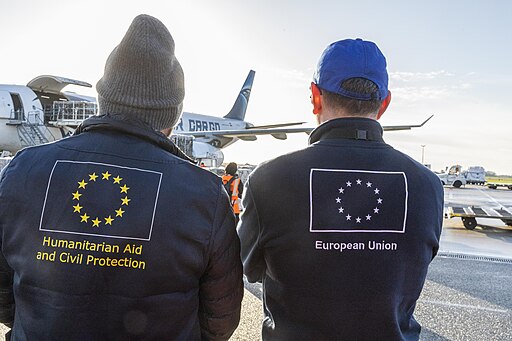
(Photo credit: Wiki Commons)