
The Washington Agreements: Peace for Business is not Enough
In
“I actually stopped the war with Congo and Rwanda and they said please please we would love you to come and take our minerals – which we’ll do.”
09 12 2025 US President Donald Trump
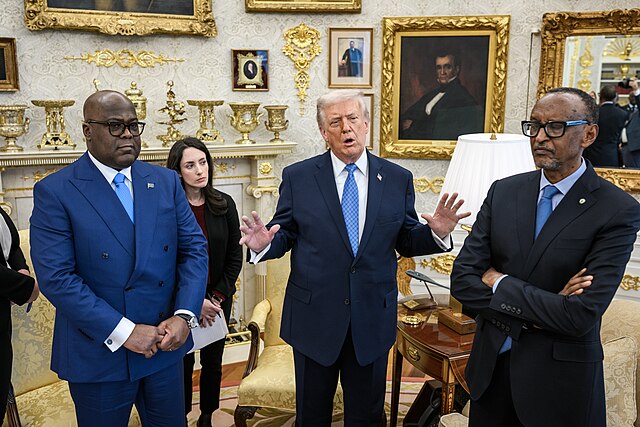
On 4 December, five agreements were signed in Washington by the presidents of DRC and Rwanda in an official ceremony: a peace agreement between the DRCongo and Rwanda, a regional integration framework agreement between the same, a strategic partnership agreement between the U.S. and the DRC, a U.S.-Rwanda Framework for Shared Economic Prosperity and a MoU between the US and the DRC concerning an expanded security partnership.
*****
The Washington agreements: peace for business is not enough
On 4 December, five agreements were signed in Washington by the presidents of DRC and Rwanda in an official ceremony: a peace agreement between the DRCongo and Rwanda, a regional integration framework agreement between the same, a strategic partnership agreement between the U.S. and the DRC, a U.S.-Rwanda Framework for Shared Economic Prosperity and a MoU between the US and the DRC concerning an expanded security partnership.
This reportedly happened only after heavy US pressure on the two parties and despite the absence of a final, and essential, agreement in Doha about the withdrawal of the M23 troops from the Kivus. On the positive side, it created a frame of reference for all involved parties to orient any peace efforts. On the negative side, neither the DRC nor the increasingly imperialist Rwanda seem to be really committed to peace. So why did the USA put so much pressure for its signing?
Beyond the vanity of the US president and his Nobel price ambitions, the “partnership agreement between the government of the USA and the government of the DRC” (almost ignored by the public), may provide part of the answer. This cooperation agreement covers many grounds, from economy to security and defense, from science, technology and education to institutions and governance. However, at the center of the agreement are the “critical mineral assets” that the US wishes to control, all the way from exploration to the offtake. Art. IV 1 says “The DRC shall designate an initial list of critical mineral assets, gold assets and unlicensed exploration areas as part of the Strategic Asset Reserve (ASR).” From the official US list of critical minerals, cobalt, copper, germanium, lithium, manganese, niobium, tantalum, tin, tungsten and zinc are to be found in the DRC. However, only tungsten and niobium are exclusively exploited in the Eastern part of the country where the current conflict is taking place. Gold, on the other hand, included in the “strategic asset reserve”, is to be found all over the DRC but is an important source of financing for the conflict in East Congo.
The general idea is to facilitate and guarantee investments for US companies and persons, which may cover various domains but with a clear priority for projects related to critical minerals, to secure access to relevant supply chains for the U.S. So-called “qualifying strategic projects” open for investment in the area covered by the “strategic asset reserve”, must meet a series of criteria among which guaranteed control of the project by a US person or entity, offtake on the US market, transport through the Lobito corridor. These projects cover exclusively These projects must relate to the field of mining (exploration, exploitation etc.) or mining-related infrastructure. Priority is given to projects in remote areas, post-conflict areas (East Congo obviously), and/or involve value addition by transformation inside the DRC.
Beyond the “qualifying strategic projects” linked to the mining sector, the DRCongo can also present so-called “designated strategic projects” which may cover other areas then the abovementioned. The USA commits to assistance in securing financing but for implementation the DRC must prioritize partnerships with US citizens and companies.
For these projects, the DRC commits to a preferential fiscal, tax and regulatory incentives systems for US persons and aligned persons[1], which also entails a commitment for the DRC to ensure any necessary legislative and constitutional reforms (within 12 months) (art. XII 2a). These reforms must basically protect US investors against fiscal harassment.
The agreement is supervised by a joint steering committee composed of officials from both countries[2] which must ensure the attainment of the ambitious objectives referred to above.
In order to avoid the production of these mining sites being shipped to China, offtake agreements for the US markets are required but also exportation through the Lobito Corridor – called “Sakania-Lobito” corridor to provide for a possible extension from Tenke (the current end station) to Sakania in the DRC. The US commits to promote financing of the rehabilitation of the Congolese section of the Lobito railway. The agreement projects to increase the volume of critical minerals to be transported through the Lobito corridor to 50% of copper, 90 % of zinc concentrate, and 30% of cobalt within five years.
Finally, the US intends to establish a coordination and governance committee for the Grand Inga Hydropower project in DRC to promote, again, US interests.
The US’ interest in the agreement is obvious, but the DRC’s ? In signing this agreement, President Tshisekedi chooses a strong alignment with the USA, radically reducing the strategic margins for the DRCongo in cooperation with other partners. One may wonder why?
A first reason is possibly to be found in the unpublished MoU on security cooperation, also signed on 4 December. It may offer guarantees for pressure on Rwanda to end its control of East Congo, although an MoU must necessarily be of a general nature. Pure and simple respect of elementary international law (more specifically Security Council Resolution 2773 of 21 February 2025) is not a high return for a total commitment of the DRC critical mineral sector to the USA; but the latter country may be the only hope for the DRC to force Rwanda to leave the country – at least that might be how the DRC government or presidency think. The announced withdrawal of the AFC/M23 after US pressure points in that direction.
A second reason may be a preference for investments by listed US companies over Chinese companies which are much more difficult to hold accountable. One may in principle also expect better working and payment conditions from the former. The suggested assistance for rehabilitation of the Lobito corridor railway in Katanga is an important asset. On the other hand, due to much more stringent regulations on corruption, the prospects for side deals with US companies are less interesting for money-hungry members of the ruling elite.
A third reason may be related to the constitutional reform or replacement projected by President Tshisekedi. A report from the “Constitutional review committee” was to be presented on 10 December at the opening of the planned congress of the UDPS presidential political party[3]. The agreement with the US could be a safeguard against US criticism, even if the November 2025 US National Security Strategy already states that the US does not wish to impose “democratic or other social change that differs widely from their tradition and histories”.
A further question is whether the USA will be able to achieve the objectives spelled out in the strategic partnership agreement. The November 2025 USA National Security Strategy mentions Africa in half a page at the end of the document, saying that: “The United States should transition from an aid-focused relationship with Africa to a trade- and investment focused relationship, favoring partnerships with capable, reliable states committed to opening their markets to US goods and services”. Even if the agreement includes an important number of safeguards for US investors, including favorable modifications of DRC laws and regulations, Rwanda and Zambia still have a much better reputation in terms of capacity and reliability (at least for investors) than the DRCongo which has a long way to go to improve its business climate.
Moreover, the “strategic asset reserve” and the projected investments by US firms (notably Kobold Metals, based in Zambia) concern first and foremost Katanga much more than East Congo. Exploitation of tantalum or gold (explicitly mentioned in the partnership agreement) is perfectly possible by purchasing it in the DRCongo and transforming and exporting it in and from Rwanda, as was spelled out by the Chief Compliance Officer of Trinity Metals[4], a private British-American company which is part of the portfolio of Ngali holdings, the economic instrument of the Rwandan Defense Forces. Agreements between the USA and Rwanda about supply of tin and tungsten were also concluded this year with the same Trinity Metals. The importance of the East for tantalum[5], which is undeniable because of the low cost and high grade of coltan ore from North Kivu’s Rubaya mine, must be counterbalanced by the increasing production of tantalum in Katanga: the US could bet on both supply chains. The partnership agreement between the US and Rwanda was not published, nor was the MoU on security between the DRC and the USA; but from an economic point of view, the US could live with access to East Congo natural resources through Rwanda and to the Katanga minerals through Zambia. Nothing in the “Regional Integration Framework” between DRCongo and Rwanda prevents the US from doing so, at least if, as is spelled out in the regional framework, transparent supply chains are introduced in East Congo (then towards Rwanda) and the current economic sanctions are lifted.
In any case, the fundamental problems remain political (monopolization of power in Kinshasa, lack of reconciliation in East Congo) and military (no DRC army and terrible violence in Ituri). The US has also for long put a blind eye to the expansionist policy of Paul Kagame.
Political leaders are not simply calculating businessman; they have political-military projects for which they need resources and legitimacy.
[1] Aligned persons are persons not belonging to countries considered to be adversaries to the USA as China, North Korea, Cuba etC.
[2] Remarkably, the Minister of Mines is not included on the Congolese side.
[3] https://congres-udps.org/programme (accessed 10 12 2025)
[4] Tristan Minyati, Strategic minerals, strategic peace: unlocking shared prosperity in Africa’s Great Lakes region, in The New Times, Kigali, 11 August 2025.
[5] Tantalum is more important in strategic than in financial terms. Supply of tantalum worldwide is sufficient and certainly not limited to the DRCongo.
(Photo credit: Wikimedia Commons)