
Belgian Defense Going Tropical: A Return in Focus to Africa
In
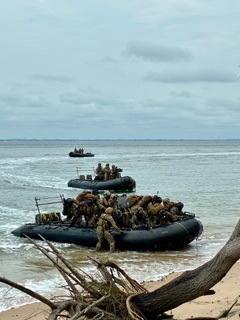
Twenty-eight Belgian paratroopers are jumping in a static line down on a small Gabonese island just outside of the capital Libreville, while para commandos are jumping out of three zodiac boats arriving at the shore of the island. These are demonstrations of Tropical Storm, one of the largest military exercises of the Belgian defense, gathering 1200 Belgian troops alongside 500 Gabonese troops during a month between November and December.
*****
Belgian Defense Going Tropical: A Return in Focus to Africa
Twenty-eight Belgian paratroopers are jumping in a static line down on a small Gabonese island just outside of the capital Libreville, while para commandos are jumping out of three zodiac boats arriving at the shore of the island. These are demonstrations of Tropical Storm, one of the largest military exercises of the Belgian defense, gathering 1200 Belgian troops alongside 500 Gabonese troops during a month between November and December. The sheer size of the exercise indicates its importance, and so does the visit of the Belgian Minister of Defense and the Chief of Defense, the latter who arrived jumping out of a helicopter on the island just before the paratroopers jumped out of the plane. Yet so far Africa has been marginalized in Belgium’s latest defense discussions due to commitments in the East related to the Ukraine war. Are these events indications that Africa finally is back in focus in Belgian security and defense debates?
A costly disregard of Africa
An understandably strong military focus on the Eastern flank following Russia’s full-scale intervention in Ukraine in 2022, in combination with a new coup wave in Africa, drew European and Belgian military attention away from Africa. This was evidenced both in the Minister of Defense’s comments during the Diplomatic Days and in the Strategic Vision of 2025, where Africa was described as important, but not a priority. A costly omission in a geopolitical context where Africa’s minerals and natural resources are in focus during the current global power competition, prompting China, Russia, and middle powers, such as Türkiye and the Gulf states to increase, rather than decrease, their presence.
The exponential demographic increase on the continent, going from approximately 1 to 2 billion people between 2020 and 2050, is alone a reason to keep Africa on the radar of European capitals, not only for the possibility of migration but also for cooperation. So is the world’s fastest jihadist expansion which currently is taking place on the continent, with more than a 300% increase in violent extremism between 2012 and 2022, establishing the continent as the hotbed for armed jihadist organisations.
A development that is not threatening Europe’s security today, but the speed of the growth should concern us as the closest neighboring continent for tomorrow. It should also make us at the very least aware of the possibility that we might get requests from our African partners to intervene militarily at some point in the future. For that, Europe and Belgium need to maintain their expeditionary capabilities and capacity to operate in a tropical environment, both of which are the overarching aims of Tropical Storm.
Tropical Storm: A supersized exercise
This year’s Tropical Storm exercise is the fifth one organized in Gabon since 2015, after a break in 2023 following the military coup in the country. As elections in 2025 ended the transition period, the Special Operations Regiment (SOR), took up where it left off in 2021 and organized one of the largest joint exercises so far undertaken, involving two A400M aircrafts, three A-109 helicopters, fifteen motorboats and about 180 vehicles, all of which were deployed from Belgium to Gabon. The deployment of equipment started already at the end of October, while the actual exercise debuted on the 12th of November and ended on the 10th of December. An initial entry scenario planned in Belgium allowed for the possibility of a tactical projection of troops, whereby units took off in full combat gear in the planes departing from Belgium and jumped into a fictional counterterrorism operation in Gabon from the planes. The exercise also allowed for the troops to test new, lighter uniforms, adapted to the climate and with integrated insect repellent, a welcome development for the individual soldiers and officers on the ground.
The main strategic objectives of this year’s exercise were to renew and reinforce the Belgo-Gabonese military cooperation, maintain the SOR’s capacity for strategic, expeditionary deployment and train Gabonese troops in the SOR’s special capabilities, including close body combat. The exercise brought together several different units and international partners, including the Air force, which supplied strategic and tactical transport throughout the exercise with its two A400M aircrafts, while the medical component assured medical support to all deployed troops. From a logistical perspective, the sheer number of vehicles and equipment to transport implied more than 130 flights back and forth between Gabon and Belgium and 2.3 million euros’ worth of shipment of equipment, indicating the large size and cost of the exercise.
A welcoming host
Contrary to previous years’ editions, this time the Gabonese troops operated entirely under Gabonese command within the exercise, allowing for a more realistic scenario while also reflecting the current continental focus on sovereignty and independence from Western militaries. Yet, at the same time Gabon is a welcoming host for Western troops while simultaneously maintaining good relations with Russia by providing shelter for the fleet of shadow vessels that carry sanctioned oil. It is the only former French colony that has experienced a coup in recent years which has not ended security collaboration with France. On the contrary, as you enter Libreville from the airport, large posters picturing a smiling Macron with a “Welcome Back” message are bordering the road alongside other ones where President Nguema is shaking hands with Macron under a headline declaring a “win-win” collaboration.
Western states’ partners in Africa are today few and far between, following the recent coup wave and the expulsion of Western and multilateral partners in a strong anti-Western trend. The latest state to experience a coup attempt on the continent, Benin, is also one of the few countries still welcoming Western troops, including Belgian troops, hence the strong interest from Western states to maintain a friendly government in place. Maintaining connections with the states that do welcome Western presence seems therefore logical, as long as the governments – military or not – are not committing atrocities against their own (or other) populations. Gabon is far from that, and while its new President has understood how to play the hand of both Russia and Western partners, this co-existence might just have to be something for Western and multilateral actors to get used to, if they want to remain present in Africa.
Afrique Je t’aime?
In an interview with the Belgian Defense Minister during the Tropical Storm exercise, he made a U-turn from previous statements about limited military engagement in Africa and declared plans for new military collaborations with partners on the continent, to be revealed in an operational plan before the Council of Ministers in December, while declaring his love for Africa on Instagram. So far, the contents of the plan are still unknown, but given the Belgian Defense’s current collaborations in and with Benin, intended to become the new logistical hub on the African continent for Belgian deployments, it is not farfetched to imagine a scale-up of engagement there, depending of course on the outcome and aftermath of the recent coup attempt. Belgium’s long-term military cooperation with the DRC, which include its current role as the lead nation for the European Peace Facility (EPF) funds attributed to the DRC, might also be part of reflections for stronger engagement. Where and how Belgium’s military focus should go on the African continent is up for further debate and discussion, but the answer to the If question should at this point be clear: a continued engagement with African partners should be a priority.
(Photo credit: Nina Wilén)